


Diversify your Portfolio - Buy Platinum
Buy Platinum: Buy The Most Precious of the Precious Metals
It’s rarer than gold. Over fifteen times rarer, in fact. The annual supply of platinum -- about 130 tons -- is the equivalent of just 6 percent of gold’s annual production. There’s twice as much steel poured everyday as platinum produced in one year.
Even so, platinum, the hardest of the precious metals, has far more industrial uses than either gold or silver. And half of the annual supply of platinum involves industrial consumption of the beautiful silver/white metal, which means that these consumed supplies need to be regularly replenished. Auto catalytic converters and platinum’s role as a catalyst in “cracking” crude oil are both examples of applications that consume this metal. And highlights why it’s in such demand.
A Formula for Demand
 Platinum peaked in popularity in the early 1900's when it was the preferred metal for all fine jewelry in America. But, when World War II began, the U.S. government declared platinum a "strategic" metal (largely for its vital role in the Manhattan Project in 1940), thereby prohibiting it from such non-strategic uses as jewelry.
Today, however, the strategic and industrial uses, its popularity in jewelry and its coin and bar investment forms are all reasons why platinum has returned to its former glory days. This great demand, coupled with virtually no above ground supplies, a difficult production process (it takes 20,000 pounds of ore to generate just one ounce of platinum) and a politically-turbulent South African mining source (90 percent of the annual supply of platinum comes from just four mines), could make for great potential.
Popular Platinum Coins
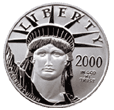
The U.S. Mint began producing America’s first platinum coins on June 6, 1997. The Platinum Eagle quickly became one of the most popular platinum coin in the world.
Buy Platinum Coins
Consider diversifying your paper and gold holdings with platinum coins. When you buy a platinum coin, you'll benefit from the relative rarity of the metal and its outlook for long term growth.
The costs of investing in this precious metal, when compared to other precious metals such as gold or silver, may be discouraging for average investors. As with all other investments, buyers should understand the nature of investment. Platinum’s relative scarcity when compared to other precious metals such as gold or silver, gives platinum a higher potential as an investment as there is lesser of this precious metal available than gold or silver.
What Should You Keep In Mind When You Buy a Platinum Coin
Platinum has become one of the most sought after metals in recent times. This precious metal has a great tensile strength, thus making it a popular precious metal choice for fine jewelry where diamonds and other precious gems need to be held in place safely and easily. This precious metal has a high resistance to corrosion than compared to other precious and semi-precious metals.
As the demand for this precious metal is spiraling upwards, the continual demands placed on the tight platinum supply will ensure the value of this precious metal will only increases in the future.
About Platinum As a Metal
Platinum belongs to 'The Royal Family' of metals. The Royal Family, also known as the Noble Metals, is based on a group of metals having the same characteristics and traits which includes precious metals like gold, silver, and palladium. Platinum and other members of the Noble Metals have a very high resistance to oxidation, thus making it a coveted choice for making jewelries as well.
The statements made on this Website are opinions only. Past results are no guarantee of future performance or returns. Precious metals, like all investments, carry risk. Precious metals and coins may appreciate, depreciate, or stay the same depending on a variety of factors. Lear Capital, LLC cannot guarantee, and makes no representation, that any metals purchased will appreciate at all or appreciate sufficiently to make customers a profit. Lear is a retail seller of precious metals and its buyback (or bid) prices are lower than its sell (or ask) prices. Metals must appreciate enough to account for this difference in order for customer to make a profit when liquidating the metals. Lear does not provide financial advice or retirement planning services. The decision to purchase or sell precious metals, and which precious metals to purchase or sell, are the customer’s decision alone, and purchases and sales should be made subject to the customer’s own research, prudence and judgment.